
Climate Change, Health and Environment (CCHE) is committed to maintaining the highest standards of scientific quality, integrity, transparency, and fairness throughout the editorial and peer-review process. Every manuscript submitted to the journal undergoes a structured evaluation designed to ensure that published articles are scientifically rigorous, ethically sound, and relevant to the journal's interdisciplinary scope.
CCHE operates a single-blind peer-review system in which the identities of both authors and reviewers remain anonymous throughout the review process. This model is intended to minimize potential bias, promote objective evaluation, and ensure that editorial decisions are based solely on scientific merit.
The peer-review process is conducted in accordance with the principles of the Committee on Publication Ethics (COPE) and follows internationally recognized best practices in scholarly publishing. Editors, reviewers, and authors are expected to comply with the journal's editorial policies, publication ethics, and confidentiality requirements at every stage of the review process.
Each manuscript is evaluated for its originality, scientific significance, methodological rigor, ethical compliance, clarity of presentation, and contribution to advancing interdisciplinary knowledge in climate change, environmental science, human health, and sustainability.
The Editorial Office continuously monitors the efficiency, fairness, and quality of the peer-review process to ensure timely editorial decisions while maintaining rigorous scientific standards.
Figure 1 summarizes the editorial and peer-review workflow adopted by CCHE. The process is designed to ensure fairness, transparency, scientific rigor, and timely editorial decision-making. Each submitted manuscript undergoes administrative screening, editorial assessment, independent single-blind peer review, editorial evaluation, and, where necessary, revision before reaching a final publication decision.
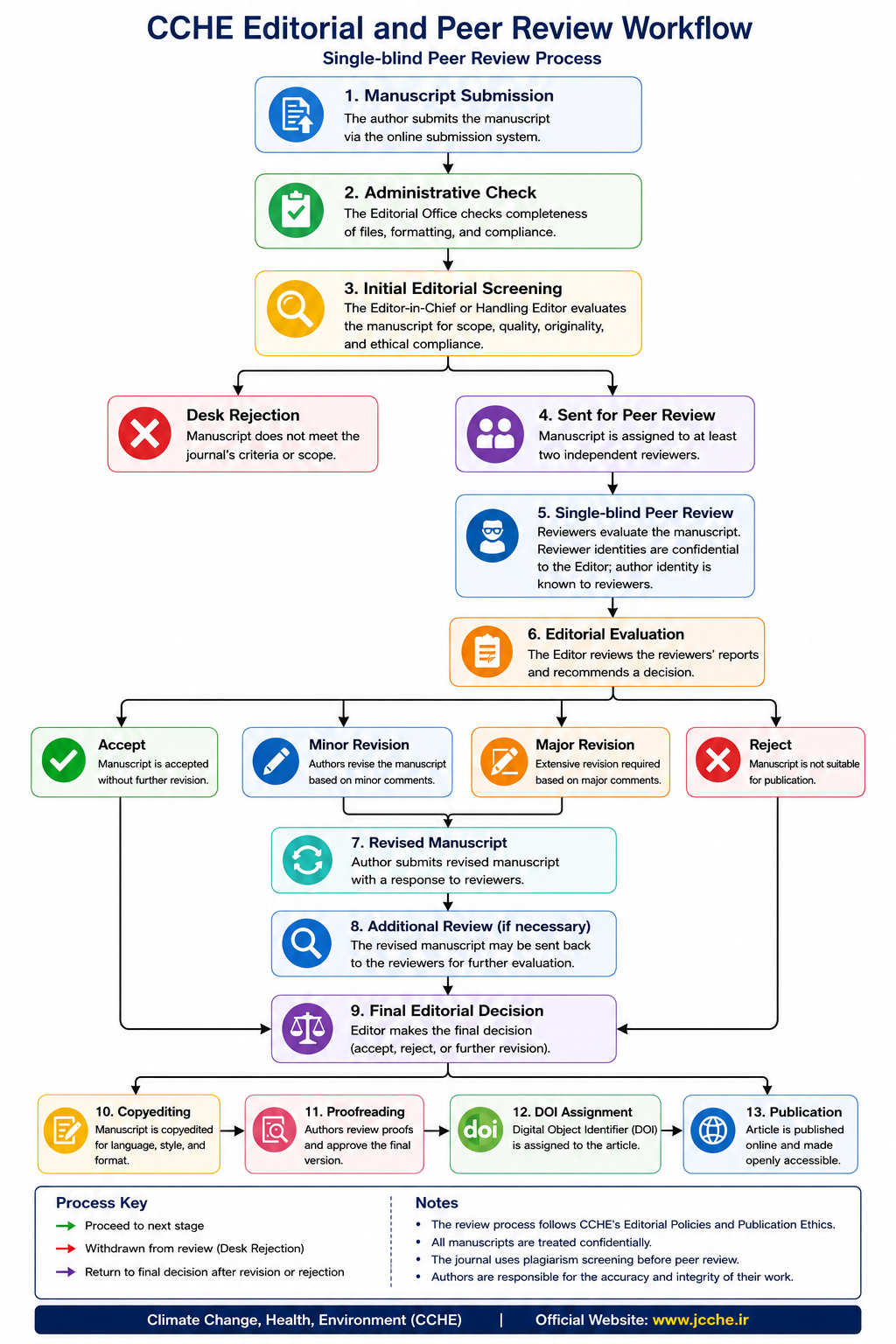
Figure 1. Editorial and Peer Review Workflow of Climate Change, Health and Environment (CCHE)
Following submission, every manuscript undergoes an Administrative Screening conducted by the Editorial Office before it is forwarded to the Editor-in-Chief or a Handling Editor for scientific evaluation. This preliminary stage is designed to ensure that all submissions comply with the journal's administrative, technical, and ethical requirements.
The Administrative Screening is intended solely to verify the completeness and compliance of the submission. It does not involve an assessment of the manuscript's scientific quality, originality, novelty, or suitability for publication.
During this stage, the Editorial Office verifies the following:
Completion of all required submission files and accompanying documents.
Compliance with the journal's manuscript preparation and formatting requirements.
Accuracy and completeness of author information, affiliations, corresponding author details, and ORCID iDs (where provided).
Inclusion of the title, abstract, keywords, references, figures, tables, and supplementary materials, where applicable.
Submission of mandatory declarations, including:
Author Contributions;
Conflict of Interest Statement;
Funding Statement;
Acknowledgements (if applicable);
Ethics Approval and Informed Consent statements, where required;
Data Availability Statement.
Compliance with the journal's language and presentation standards.
Similarity screening using iThenticate to identify potential text overlap and ensure originality.
Verification that the manuscript falls within the general thematic scope of the journal before editorial assignment.
If administrative deficiencies are identified, the manuscript may be returned to the corresponding author with a request for correction or completion before entering the editorial evaluation process.
Manuscripts that successfully satisfy all administrative requirements proceed to the Initial Editorial Assessment. Completion of the Administrative Screening does not imply acceptance for peer review or publication.
Following Administrative Screening, one of the following outcomes may occur:
Proceed to Initial Editorial Assessment when all submission requirements have been satisfactorily met.
Return to the Author for Technical Correction if administrative information or required documents are incomplete or require revision.
Administrative Withdrawal in exceptional circumstances where essential submission requirements are not fulfilled after repeated requests or where serious administrative or ethical concerns are identified prior to editorial evaluation.
The Administrative Screening stage enables the Editorial Office to maintain an efficient editorial workflow while ensuring consistency, transparency, and compliance with the journal's editorial policies.
Following successful completion of the Administrative Screening, each manuscript undergoes an Initial Editorial Assessment conducted by the Editor-in-Chief or an assigned Handling Editor. This stage serves as the journal's primary scientific screening before external peer review.
The purpose of the Initial Editorial Assessment is to determine whether the manuscript is suitable for external review based on its scientific quality, originality, ethical compliance, and relevance to the journal's aims and scope.
During this assessment, the Editor evaluates the manuscript according to several criteria, including:
Relevance to the aims and scope of Climate Change, Health and Environment (CCHE).
Scientific originality and potential contribution to the field.
Importance and novelty of the research question.
Overall methodological quality and scientific rigor.
Compliance with research and publication ethics.
Clarity, organization, and overall presentation of the manuscript.
Potential interest to the journal's readership.
Suitability for external peer review.
The Initial Editorial Assessment is an independent editorial evaluation and does not involve external reviewers.
A manuscript may be declined without external peer review (Desk Rejection) when it:
Falls outside the journal's aims and scope.
Demonstrates insufficient scientific quality or originality.
Contains fundamental methodological weaknesses that cannot reasonably be addressed through revision.
Fails to comply with the journal's ethical standards or publication policies.
Presents inadequate reporting, poor organization, or language issues that substantially hinder scientific evaluation.
Shows excessive text similarity or raises concerns regarding research integrity.
Does not meet the journal's minimum standards for peer review.
Desk rejection enables authors to receive an early editorial decision and allows the journal to allocate reviewer resources efficiently to manuscripts with appropriate scientific potential.
Editorial decisions are made independently and objectively. Editors evaluate manuscripts solely on their academic merit, scientific quality, ethical compliance, and relevance to the journal.
Editorial decisions are made without discrimination based on the authors' nationality, ethnicity, gender, institutional affiliation, political views, religious beliefs, or other personal characteristics unrelated to the scientific content of the manuscript.
Following the Initial Editorial Assessment, one of the following decisions is made:
Proceed to External Single-Blind Peer Review.
Return to the Author for Pre-Review Revision, where minor editorial or presentation issues require correction before peer review.
Desk Rejection, where the manuscript is not considered suitable for external review.
Authors are informed of the editorial decision together with appropriate comments whenever applicable.
The Initial Editorial Assessment is an essential component of the journal's quality assurance process and contributes to maintaining an efficient, fair, and scientifically rigorous peer-review system.
Before peer review, the Editorial Office or Editor may request authors to revise their manuscript to improve compliance with the journal's submission requirements or reporting standards. Completion of a Pre-Review Revision does not imply acceptance for peer review or publication.
Manuscripts that successfully pass the Initial Editorial Assessment are forwarded for external Single-Blind Peer Review.
Under the single-blind review model adopted by Climate Change, Health and Environment (CCHE), reviewers are aware of the identity of the authors, while the identities of the reviewers remain confidential and are not disclosed to the authors unless otherwise determined by the journal.
The objective of peer review is to provide an independent, objective, and constructive evaluation of the scientific quality, originality, methodological rigor, ethical compliance, and overall contribution of the manuscript.
Reviewers are selected by the Editor-in-Chief or the assigned Handling Editor based on their expertise, research experience, publication record, and absence of conflicts of interest relevant to the submitted manuscript.
Whenever possible, reviewers are chosen from different institutions to ensure an independent and balanced evaluation.
The journal normally assigns at least two independent reviewers to evaluate each research manuscript. Where necessary, additional reviewers or subject specialists may be invited to provide further expert assessment.
Reviewers are invited to evaluate manuscripts based on several scientific and editorial criteria, including:
Originality and scientific contribution.
Relevance to the aims and scope of the journal.
Importance and significance of the research.
Soundness of the study design and methodology.
Quality of data analysis and interpretation.
Ethical compliance and research integrity.
Clarity, organization, and quality of presentation.
Appropriateness and currency of references.
Validity of the conclusions and their support by the presented evidence.
Reviewers are encouraged to provide constructive, respectful, and evidence-based comments that assist both the authors and the Editors in improving the quality of the manuscript.
Following completion of the review, reviewers are generally invited to recommend one of the following editorial actions:
Accept.
Minor Revision.
Major Revision.
Reject.
Reviewer recommendations are advisory in nature and do not constitute the final editorial decision.
The Editor carefully considers all reviewer reports together with the scientific merit of the manuscript before reaching an editorial decision.
Where reviewer opinions differ substantially, the Editor may:
consult an additional independent reviewer;
seek advice from a member of the Editorial Board;
request clarification from one or more reviewers before making a decision.
The final publication decision rests solely with the Editor-in-Chief or the responsible Handling Editor.
CCHE is committed to ensuring that every manuscript receives an impartial, confidential, timely, and scientifically rigorous evaluation.
All participants in the peer-review process are expected to comply with the journal's Publication Ethics, confidentiality requirements, and conflict of interest policies throughout the review process.
Following completion of the external peer-review process, the Editor-in-Chief or the assigned Handling Editor evaluates the reviewer reports together with the scientific merit of the manuscript before reaching an editorial decision.
Editorial decisions are made independently, objectively, and exclusively on the basis of the manuscript's scientific quality, originality, methodological rigor, ethical compliance, and relevance to the journal's aims and scope.
Reviewer recommendations are carefully considered during the decision-making process; however, the final decision rests solely with the Editor-in-Chief or the responsible Handling Editor.
The journal may issue one of the following editorial decisions:
The manuscript is accepted for publication without requiring further scientific revision. Minor editorial corrections or copyediting may still be undertaken prior to publication.
The manuscript is considered scientifically suitable for publication, subject to minor revisions. These revisions typically involve clarification of the text, improvement of figures or tables, correction of references, or minor methodological explanations that do not substantially affect the study's conclusions.
Authors are requested to submit a revised manuscript together with a detailed point-by-point response to the reviewers' comments within the specified timeframe.
The manuscript demonstrates scientific merit but requires substantial revision before it can be considered for publication. Major revisions may involve improvements in methodology, data analysis, interpretation of results, organization of the manuscript, or additional supporting information.
A revised manuscript will normally undergo further editorial evaluation and, where appropriate, may be returned to one or more of the original reviewers for additional assessment.
A request for Major Revision does not guarantee eventual acceptance.
A manuscript may be rejected when it does not meet the journal's scientific, methodological, ethical, or editorial standards, or when the concerns identified during peer review cannot be adequately addressed through revision.
Rejected manuscripts will not proceed further in the publication process. Authors are encouraged to consider the reviewers' comments carefully before submitting the work elsewhere.
Editorial decisions are based on a comprehensive evaluation of:
Reviewer reports and recommendations.
Scientific originality and contribution.
Methodological quality and validity.
Ethical compliance and research integrity.
Relevance to the journal's aims and scope.
Clarity, transparency, and completeness of reporting.
Editors may also consider the consistency of reviewer comments and seek additional expert advice when necessary.
Authors receive the editorial decision through the journal's online submission system together with the reviewers' comments and any additional editorial observations intended to facilitate revision or improve the manuscript.
The Editorial Office aims to communicate editorial decisions in a timely, transparent, and constructive manner while maintaining the confidentiality of the peer-review process.
Authors receiving a decision of Minor Revision or Major Revision are invited to revise their manuscript in accordance with the comments provided by the reviewers and the Editor.
The purpose of the revision process is to improve the scientific quality, clarity, transparency, and overall presentation of the manuscript while ensuring that reviewer concerns have been appropriately addressed.
Authors should submit:
A revised version of the manuscript with all requested changes incorporated.
A detailed Response to Reviewers document addressing each reviewer comment individually.
A clear explanation for any recommendations that were not adopted, supported by appropriate scientific justification.
Authors are encouraged to provide complete, respectful, and evidence-based responses to facilitate an efficient editorial evaluation.
Following submission of the revised manuscript, the Editor evaluates whether the authors have adequately addressed the comments raised during peer review.
Depending on the nature and extent of the revisions, the Editor may:
make a final editorial decision without additional peer review;
return the revised manuscript to one or more of the original reviewers for further evaluation;
invite an additional reviewer if further expert opinion is required.
Major revisions generally require an additional round of peer review to verify that the scientific concerns identified during the initial review have been satisfactorily resolved.
Minor revisions may be assessed directly by the Editor when further external review is not considered necessary.
Authors are expected to respond to reviewer comments in a constructive, professional, and respectful manner.
Where authors disagree with a reviewer recommendation, they should provide a clear scientific explanation supported by appropriate evidence rather than simply rejecting the comment.
Constructive scientific dialogue between authors, reviewers, and Editors contributes significantly to improving the quality of published research.
If a revised manuscript is not submitted within the requested timeframe and no extension has been approved by the Editorial Office, the manuscript may be considered withdrawn from the editorial process.
Authors who anticipate delays are encouraged to contact the Editorial Office before the revision deadline to request an extension.
The revision process is an integral component of scholarly publishing and is intended to strengthen the scientific quality, transparency, and reliability of published research.
CCHE encourages collaborative and constructive communication among authors, reviewers, and Editors throughout the revision process while maintaining fairness, confidentiality, and scientific integrity.
A manuscript is considered accepted for publication only after the Editor-in-Chief or the responsible Handling Editor has determined that all scientific, editorial, and ethical requirements have been satisfactorily fulfilled.
Final acceptance is granted after careful consideration of the peer-review reports, the authors' revisions, and the overall scientific quality of the manuscript.
Acceptance for publication indicates that the manuscript has successfully completed the journal's editorial and peer-review process and is considered suitable for publication in Climate Change, Health and Environment (CCHE).
Before final acceptance, the following conditions must normally be satisfied:
All reviewer and editorial comments have been adequately addressed.
The revised manuscript meets the journal's scientific and editorial standards.
Ethical requirements and publication policies have been fulfilled.
Any required supporting documentation has been submitted and verified.
The Editor is satisfied that the manuscript is suitable for publication.
The final decision to accept a manuscript rests exclusively with the Editor-in-Chief or the responsible Handling Editor.
Reviewer recommendations provide essential scientific advice; however, acceptance decisions are made independently by the Editorial Office in accordance with the journal's editorial policies and publication ethics.
Once a manuscript has been accepted, the corresponding author will receive a formal notification of acceptance through the journal's online submission system or by official editorial correspondence.
The acceptance notification marks the conclusion of the scientific evaluation process. The manuscript then proceeds to the production stage, including copyediting, proofreading, DOI assignment, final formatting, and publication.
After final acceptance, substantial modifications to the scientific content of the manuscript are generally not permitted.
If significant issues affecting the validity, integrity, or ethical status of the manuscript are identified after acceptance, the Editorial Office reserves the right to undertake additional editorial assessment and to take appropriate action in accordance with the journal's Publication Ethics and COPE principles.
Final acceptance reflects the journal's commitment to publishing high-quality, ethically conducted, and scientifically sound research that contributes meaningfully to the fields of climate change, environmental science, human health, and sustainability.
Following final acceptance, manuscripts enter the production stage, during which they are prepared for formal publication. The production process is designed to ensure accuracy, consistency, readability, and compliance with international publishing standards.
Accepted manuscripts undergo professional copyediting to improve grammar, spelling, punctuation, consistency, formatting, and adherence to the journal's editorial style.
Copyediting is intended to enhance the clarity and presentation of the manuscript without altering its scientific content or the authors' intended meaning.
Following copyediting and typesetting, page proofs are prepared and sent to the corresponding author for final review.
Authors are requested to carefully examine the proofs for typographical, formatting, or minor editorial errors.
Proof corrections should be limited to essential corrections only. Requests for substantial changes to the scientific content after acceptance are generally not permitted unless approved by the Editor.
Each published article is assigned a unique Digital Object Identifier (DOI), ensuring persistent identification, reliable citation, and long-term accessibility of the published work.
The DOI becomes part of the permanent bibliographic record of the article and should be used whenever the article is cited.
The journal prepares and registers the bibliographic metadata associated with each published article to support discoverability, indexing, citation tracking, and long-term accessibility across scholarly information systems.
Accepted articles are published on the official journal website following successful completion of the production process.
Each published article is assigned complete bibliographic information, including publication date, volume, issue, page numbers or article identifier (where applicable), and DOI.
Once an article has been formally published, it becomes part of the permanent scholarly record.
Any post-publication corrections, expressions of concern, or retractions, where necessary, are handled in accordance with the journal's Publication Ethics policies and internationally recognized publishing standards.
CCHE is committed to publishing scientifically rigorous, ethically sound, and professionally presented articles that are permanently accessible, accurately indexed, and citable within the international scholarly community.
Climate Change, Health and Environment (CCHE) is committed to maintaining the confidentiality and privacy of all participants involved in the editorial and peer-review process. Editors, reviewers, authors, and Editorial Office staff are expected to handle all submitted materials responsibly and in accordance with the journal's ethical standards.
All manuscripts submitted to the journal are treated as confidential documents. They shall not be disclosed, discussed, copied, or distributed to individuals who are not directly involved in the editorial and peer-review process without appropriate authorization.
Editors and reviewers must not use any unpublished information obtained through manuscript evaluation for personal research, professional advantage, or any other unauthorized purpose.
The journal operates a Single-Blind Peer Review system in which reviewer identities remain confidential throughout the editorial process.
Reviewer identities, review reports, editorial correspondence, and internal editorial discussions are treated as confidential and are not disclosed except where required by law or journal policy.
Personal information provided during manuscript submission, including names, affiliations, email addresses, and other contact details, is collected solely for editorial and publishing purposes.
Such information is handled securely and is not shared with third parties except when necessary for the normal operation of the publication process or where disclosure is required by applicable laws or regulations.
Editors and reviewers are expected to:
maintain strict confidentiality throughout the editorial process;
avoid unauthorized sharing of manuscripts or review materials;
protect confidential information obtained during manuscript evaluation;
disclose any actual or potential conflicts of interest before participating in the review process;
refrain from using unpublished material for personal benefit.
The Editorial Office takes reasonable administrative and technical measures to safeguard manuscript files, reviewer reports, editorial correspondence, and personal information against unauthorized access, loss, or misuse.
Maintaining confidentiality is fundamental to preserving the integrity, fairness, independence, and credibility of the peer-review process. All participants are expected to uphold these principles throughout every stage of manuscript handling and publication.
The editorial and peer-review process of Climate Change, Health and Environment (CCHE) is conducted in accordance with internationally recognized principles of publication ethics, research integrity, fairness, transparency, and editorial independence.
The journal is committed to ensuring that every manuscript is evaluated solely on its scientific merit, without discrimination based on the authors' nationality, ethnicity, gender, institutional affiliation, religious beliefs, political views, or other personal characteristics unrelated to the scientific content of the work.
Editors, reviewers, authors, and Editorial Office staff are expected to adhere to the journal's ethical policies throughout every stage of manuscript handling.
All participants should:
act honestly, fairly, and professionally;
maintain confidentiality during the editorial process;
disclose any actual or potential conflicts of interest;
avoid any form of bias or discrimination;
comply with the journal's Publication Ethics policies.
Submitted manuscripts are expected to represent original research conducted in accordance with accepted scientific and ethical standards.
The journal does not tolerate scientific misconduct, including but not limited to:
plagiarism;
duplicate or redundant publication;
data fabrication or falsification;
image manipulation intended to mislead;
inappropriate authorship practices;
undisclosed conflicts of interest;
unethical research involving human participants or animals.
Suspected misconduct will be investigated in accordance with the journal's Publication Ethics policies and internationally accepted ethical guidelines.
Editorial decisions are made independently and without inappropriate influence from the journal owner, publisher, sponsors, advertisers, or any external organization.
Scientific quality, methodological rigor, ethical compliance, and relevance to the journal's scope remain the sole basis for editorial decision-making.
Where concerns arise regarding research ethics, publication ethics, authorship, data integrity, or other ethical matters, the Editorial Office may request additional information, supporting documentation, or institutional clarification before reaching a final editorial decision.
Where appropriate, the journal may seek advice from members of the Editorial Board or other independent experts to ensure that ethical concerns are addressed fairly and consistently.
CCHE is committed to maintaining the highest standards of ethical publishing and scientific integrity. Upholding these principles protects the credibility of the journal, strengthens public trust in published research, and promotes responsible scientific communication within the international research community.
Climate Change, Health and Environment (CCHE) is committed to ensuring that all editorial decisions and publication processes are conducted fairly, transparently, and in accordance with the journal's editorial policies and ethical standards.
Authors, reviewers, and readers have the right to raise concerns regarding editorial decisions or the conduct of the editorial and peer-review process.
Authors who believe that an editorial decision was based on a misunderstanding, factual error, or procedural concern may submit a written appeal to the Editorial Office.
Appeals should clearly explain the reasons for the request and provide supporting evidence where appropriate.
Appeals should not consist solely of disagreement with reviewer comments or editorial judgments but should identify specific issues that may have affected the fairness or accuracy of the editorial decision.
Upon receipt of an appeal, the Editor-in-Chief or an appropriately designated senior editor will conduct an independent evaluation of the case.
Where necessary, additional expert opinions or further editorial consultation may be sought before a final decision is reached.
The outcome of the appeal will be communicated to the corresponding author in writing. Decisions made following the appeal process are considered final.
The journal welcomes complaints concerning any aspect of its editorial or publication process, including but not limited to:
editorial procedures;
peer-review conduct;
publication ethics;
conflicts of interest;
unreasonable delays;
inappropriate communication;
suspected breaches of confidentiality.
Complaints are reviewed objectively, confidentially, and without prejudice.
Where appropriate, the Editorial Office may consult the Editor-in-Chief, Editorial Board members, the Publisher, or other independent experts to ensure a fair resolution.
All appeals and complaints are handled:
fairly and impartially;
confidentially;
within a reasonable timeframe;
in accordance with the journal's Publication Ethics policies and internationally recognized best practices.
Submitting an appeal or complaint will not adversely affect the future consideration of manuscripts submitted by the complainant.
CCHE values transparency, accountability, and continuous improvement.
Constructive appeals and complaints contribute to strengthening editorial quality, improving publication practices, and maintaining confidence in the integrity of the journal.
Climate Change, Health and Environment (CCHE) is committed to the continuous evaluation and improvement of its editorial and peer-review processes to ensure the highest standards of scientific publishing.
The journal regularly reviews its editorial policies, peer-review procedures, ethical practices, and publication workflows to enhance efficiency, transparency, fairness, and scientific quality.
Continuous quality improvement is supported through:
periodic evaluation of editorial and peer-review procedures;
assessment of reviewer performance and editorial effectiveness;
regular updates to editorial policies in response to developments in scholarly publishing;
implementation of internationally recognized best practices in publication ethics and research integrity;
adoption of appropriate publishing technologies and editorial management systems;
consideration of constructive feedback received from authors, reviewers, readers, and members of the Editorial Board.
The Editorial Office remains committed to improving the timeliness of editorial decisions while maintaining rigorous standards of scientific evaluation and ethical oversight.
As scholarly publishing continues to evolve, CCHE will periodically review and update its editorial policies to reflect advances in publication ethics, peer-review practices, open science initiatives, digital publishing, and international publishing standards.
Through continuous quality improvement, the journal seeks to strengthen its credibility, promote excellence in scientific communication, and provide a fair, transparent, and reliable publication platform for the international research community.